
Essential Hand Tools for Woodworking: Everything You Need to Know
Carpentry is a discipline that combines art and technique, allowing wood to be transformed into functional and aesthetically pleasing objects. Since ancient times, This trade has been fundamental in the construction of homes, furniture and other elements that make up our environment. throughout history, carpentry has evolved, adapting to the needs and styles of each era, which underlines its cultural importance and its relevance today.
In modern times, carpentry is not only limited to construction and design, but it has also become a form of self-expression and craftsmanship. The ability to work with wood allows carpenters to unleash their creativity, creating unique pieces that are both functional and artistic. Whether you are an amateur just starting out in the field or a seasoned professional, knowing manual tools is essential to master this practice. hand tools, although often underestimated in the age of technology and machines, offer unmatched control and precision during the work process.
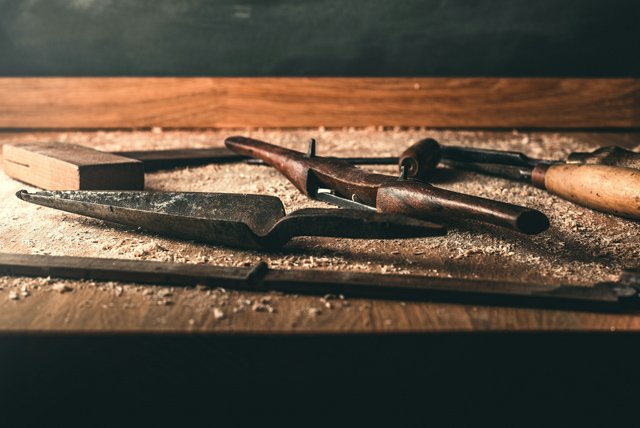
The use of hand tools in carpentry allows for fine and detailed finishes., which is essential for projects that require finesse. These tools give the carpenter the opportunity to interact directly with the material., adjusting your technique in real time and achieving more satisfying results. Through its use, a greater connection can be achieved between the work and the artist, fostering a greater appreciation for the processes involved. Therefore, Understanding and mastering hand tools is essential for any enthusiast or professional in the field of carpentry..
Types of hand tools for woodworking
Carpentry is a discipline that requires specific skills and, above all, proper use of hand tools. These tools can be categorized into several classes, each one with a different purpose that facilitates the work of carpenters. The four main categories are: cutting tools, measuring tools, clamping tools and finishing tools.
Las cutting tools They are essential to shape the wood. Among them are mountain ranges, carpenter's knives and chisels. The mountains, For example, They can be manual or miter type, and are used to make precise cuts at different angles. For your part, carpenter knives are ideal for making finer, more detailed cuts. Chisels are useful for roughing and finishing the corners and edges of wooden pieces..
Las measuring tools They are essential to ensure that each piece of wood fits precisely. a calibrator, A tape measure and a square are examples of tools that allow you to verify dimensions and angles.. Using measuring tools accurately is crucial to avoid costly errors in the final project., ensuring parts fit together correctly.
As for the clamping tools, These allow the wood to be held in place while working on it.. The bench vices, vises and clamps are common examples. These tools facilitate stability and control during the cutting and assembly stages.
Finally, las finishing tools They are necessary to polish and give the final touch to carpentry projects. Sanders, Hand planes and scalpels are tools that allow the carpenter to smooth surfaces and achieve a professional finish. These tools not only beautify the final work, but also prevent splinters, making the piece safer to the touch.
Cutting tools: saws and chisels
Cutting tools are essential in the world of carpentry, as they allow the wood to be shaped precisely. Among the most used tools, hand saws are found, jigsaws and chisels. Each of these tools performs specific functions and offers different benefits., making them essential for any carpenter, from beginners to experts.
Hand saws are traditional tools used for straight, precise cuts in pieces of wood.. Its manual design offers greater control, which is especially useful when working on more detailed projects. It is recommended to choose a hand saw with a sharp-toothed blade, since this makes cutting easier and requires less effort. To keep these saws in optimal condition, It is important to clean them after each use and sharpen the teeth periodically.
On the other hand, Jigsaws are ideal for making curved or intricate cuts. Its electrical design provides greater speed and precision, allowing carpenters to execute complex cuts in less time. It is suggested to use appropriate blades for the type of material you are working with., as this will ensure a clean finish. Just like hand saws, It is vital to follow good maintenance practices, how to check the blades and clean the tool regularly.
Chisels are another key tool in carpentry, used to make fine, precise cuts. These instruments are essential to create joints, carvings and other details in the wood. Choosing a good quality chisel is important, and must be taken care of to avoid damage to the blade. Maintaining proper sharpening will allow for better performance and easier work on all types of woodworking projects..
In conclusion, Both saws and chisels are essential tools that improve the quality of carpentry work.. Choosing the right tools and keeping them in good condition is essential to optimize the carpenter's experience., no matter your skill level. With practice and correct use of these cutting tools, Any carpenter can achieve high quality results on their projects.
Measuring tools: precision at work
Measuring tools are essential in carpentry, as they guarantee that each cut and assembly is carried out with maximum precision. Without proper measurement, it is difficult to achieve impeccable results, which could compromise the quality of the final work. Among the most used measuring tools are tape measures., squares and levels. Each of these tools plays a crucial role in the woodworking process., facilitating the creation of accurate and well-crafted projects.
The tape measure is perhaps the most common measuring tool. With its flexible and retractable design, allows you to measure lengths with ease and convenience. When using a tape measure, It is essential to ensure that it remains taut during measurement, as well as align the tape correctly from the starting point. A practical tip is to use the zero mark on the tape, as most tape measures have a small variation at their ends which can affect accuracy. A high quality tape, preferably with a wear resistance face, It is essential to ensure accurate measurements over time.
The squads, on the other hand, They are tools that allow you to check and mark angles of 90 degrees, which is vital for precise cutting and assembly. When working in wood, Using a good quality square ensures that the corners and edges of the pieces stay straight and aligned, avoiding errors in assembly. The levels, both bubble and laser, They are equally essential to ensure that structures remain level and stable. An accurate level is key, especially when installing shelving or structures that require perfect alignment. Ultimately, Investing in quality measurement tools not only improves accuracy, but also optimizes the efficiency of carpentry work.
Clamping tools: vices and vises
In the field of carpentry, Clamping tools play a crucial role in ensuring that wooden pieces stay in place during work. The correct use of jaws and vises not only provides stability, but also prevents errors that can be costly and affect the quality of the final product.. There are multiple types of these tools, each designed to meet different requirements and working conditions.
The jaws, For example, They are essential tools that are mainly used to hold the wooden pieces firmly. Among the most common models are vise and bench vices., that attach to a stable surface and allow for a powerful and reliable grip. When selecting a clamp, It is important to consider the size of the workpieces and the pressure required to hold them in a fixed position without damaging them..
The presses, on the other hand, are equally important. They are often used in projects that require bonding or assembly of multiple parts. Presses can be of various types, such as lever presses and corner presses, each suitable for specific tasks. It is vital to choose a press that suits the type of work being done; For example, if you are assembling large parts, a lever press may be the best option for its ease of use and effectiveness.
Secure clamping in carpentry not only improves work precision, but also ensures the safety of the carpenter. An involuntary movement of a part can result in accidents, therefore, Investing in high-quality fastening tools is essential. Both jaws and vises contribute to a safer work environment, allowing the carpenter to concentrate on the creativity and quality of his work without distractions.
Finishing tools: sanders and brushes
Finishing tools are essential in the world of carpentry, as they allow you to achieve a smooth and professional surface in projects. Among these tools, sanders and brushes stand out for their ability to improve the final presentation of the wood. Each offers specific functions and effective techniques that are essential for any woodworker., from amateurs to experts.
Sanders come in various forms, including belt sanders, orbital and disk. Belt sanders are ideal for quickly removing material and leveling surfaces, while orbital sanders are perfect for more delicate jobs and to provide a smooth final finish. On the other hand, Disc sanders are used in specific applications that require more direct contact with the wood surface.. When choosing a sander, It is important to consider the type of project and the desired finish.
A crucial aspect when using sanders is choosing the right grit of sandpaper.. The coarsest grain, like him 40 o 60, It is useful for the initial stages of roughing, while the finer grains, like him 220, They are best used in the final finish. Besides, It is advisable to change the sandpaper when it begins to lose effectiveness, which will ensure a uniform finish. Keeping sanders in good condition is equally essential; This includes cleaning components and checking electrical parts to ensure optimal performance.
On the other hand, Brushes are manual tools that allow a very precise finish. There are different types of brushes, such as hand and electric toothbrushes, that help soften and smooth the wood. Hand brushes require more skill, but offer exceptional control over the finish. The key to using brushes effectively is to apply even pressure and maintain the correct angle to avoid marking the surface..
Conclusion
In summary, mastering carpentry requires not only proper selection of hand tools, but also a deep understanding of its use and constant practice. Hand tools are the extension of the carpenter, and its correct use can transform simple pieces of wood into functional works of art.. Throughout this article, We have highlighted the importance of knowing each tool, from the basics like saws and hammers, even the most specialized, like the chisel and the gouge. Each of them has a specific purpose that, when combined with the skill and technique of the carpenter, results in superior quality work.
Besides, Practice is essential to develop the necessary skills in carpentry. Accumulated experience not only improves accuracy and efficiency, but also offers opportunities to experiment with new projects and techniques. It is well known that every mistake made becomes an invaluable lesson., bringing the carpenter one step closer to mastery. In this sense, the carpentry community, both amateurs and professionals, plays a crucial role in sharing knowledge, techniques and practical tips. Active participation in forums, Workshops and discussion groups can enrich the learning experience and foster a collaborative environment.
We invite all woodworking enthusiasts to continue exploring and learning about the use of hand tools and associated techniques.. The path to mastery is a continuous journey, full of discoveries and satisfactions. Sharing that passion for wood and craftsmanship with others can only enrich the experience.. Let's continue to build a vibrant community dedicated to woodworking and creating beautiful pieces of wood.

I'm Juan Carlos, carpenter 45 years old originally from Malaga. Since I was little I have always liked carpentry., so I decided to pursue a technical career specialized in carpentry and cabinetmaking.. after graduating, I opened my own carpentry and joinery workshop.
Over the past few years I have received a great reputation for my work, which has allowed me to grow as a professional. I love my job, I am proud of it and make sure that each project leaves my workshop with excellent quality.